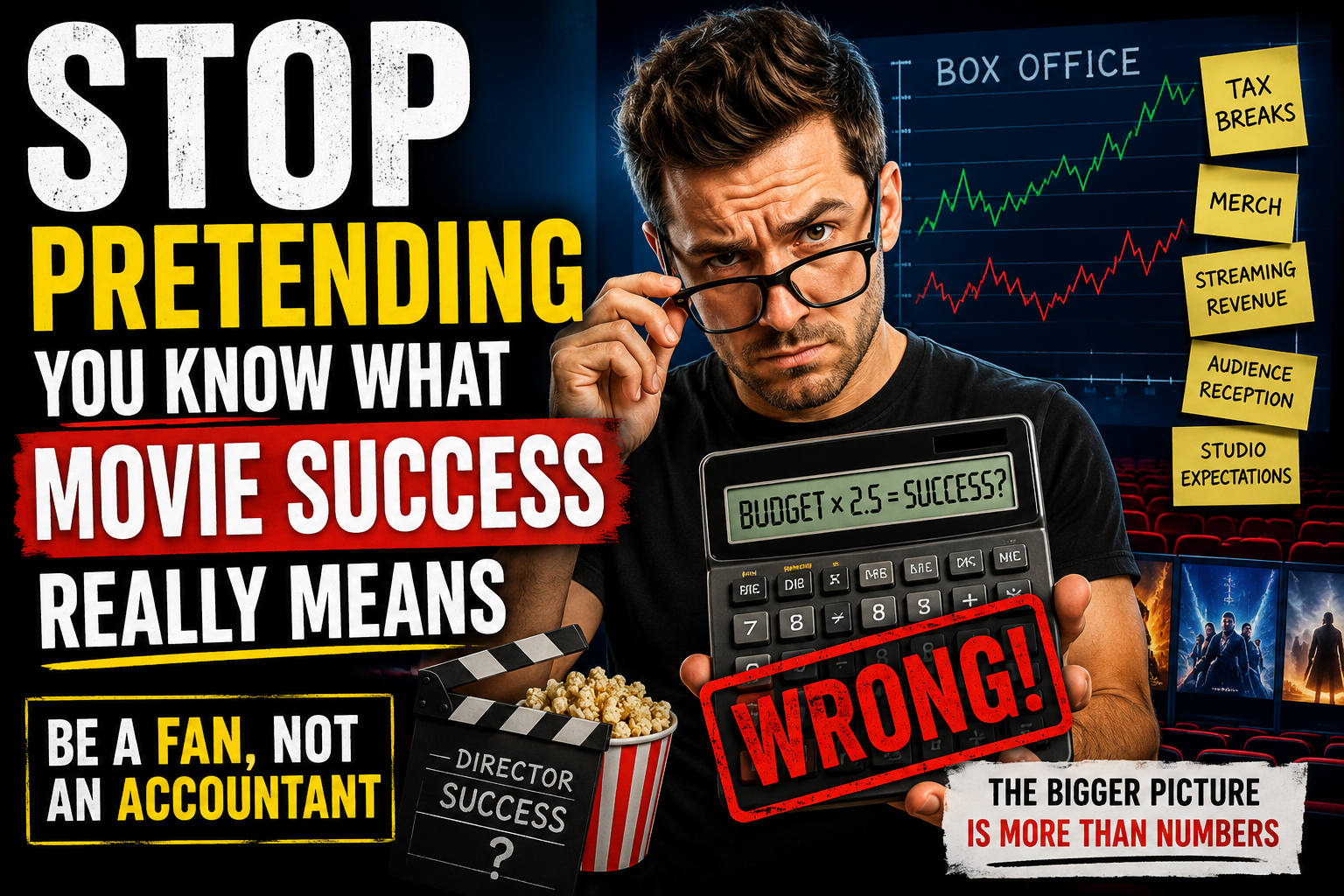
Stop Pretending You Know What Makes a Movie Successful
When did every movie fan become an accountant?
Seriously.
Somewhere along the way, discussing movies stopped being about stories, characters, performances, and whether audiences actually enjoyed the experience. Instead, every conversation became a spreadsheet. Every release became a quarterly earnings report. Every fan suddenly became an expert on profit margins, tax incentives, marketing costs and corporate finance.
The truth is…
Most people have absolutely no idea what they’re talking about.
Every time a movie releases, social media fills up with declarations.
“It’s a flop.”
“It’s a hit.”
“It needed to make three times its budget.”
“It only needed two and a half times its budget.”
“This franchise is dead.”
“This franchise is saved.”
The reality is that none of us outside the studios actually know.
Fans have created this fantasy that there is some magical formula that determines success.
Take the budget, multiply it by 2.5, and boom! You have the break even point. If the movie lands above it, success. Below it, failure.
If only it were that simple.
Studios don’t operate with a universal formula. Every film has different expectations. Different marketing spends. Different distribution deals. Different tax incentives. Different international agreements. Different merchandising opportunities.
Some films receive massive tax credits from states and countries. Some generate millions through product placement deals. Others sell mountains of merchandise. Some become streaming drivers. Others become long term library assets that generate revenue for years through rentals, purchases, licensing and syndication.
Fans don’t have access to those numbers… But you know who does?
Studios.
That’s why the internet’s favorite box office debates often miss the point entirely.
Believe it or not, a movie can underperform financially and still accomplish what a studio wanted it to accomplish.
A movie can exceed expectations while still not becoming the centerpiece of a franchise.
A movie can lose money and still get a sequel.
A movie can make money and never get another installment.
We’ve seen it happen countless times.
Look at Disney’s John Carter. The film was intended to launch a massive new franchise and become a major tentpole for the company. It didn’t happen. The box office wasn’t enough to justify the larger vision Disney had for the property, and the franchise ended before it truly began.
That tells us something important.
Success isn’t determined by fans. It’s determined by the people writing the checks.
If a studio keeps investing in a franchise, they clearly see value in it.
If they stop, they don’t. Everything else is speculation.
What’s even stranger is how often fans try comparing modern box office performances to movies released ten, fifteen or even twenty years ago.
The theatrical landscape has changed dramatically.
Streaming exists.
Premium video on demand exists.
Physical media has largely declined.
Audience habits have changed.
Ticket prices have changed.
Competition has changed.
The world has changed.
Comparing a movie released in 2026 to one released in 2011 without accounting for those differences is like comparing NFL statistics from different eras and pretending the context doesn’t matter.
Yet it happens every single day.
Even worse, many people aren’t participating in these conversations because they genuinely care about the business side of Hollywood.
They’re doing it because box office discourse gets attention.
It gets clicks, It gets engagement, It gets followers.
Declaring a movie a disaster or a triumph before the dust has settled is often more about internet points than actual analysis.
The uncomfortable truth is that most fans are approaching these conversations with heavy bias.
If they wanted the movie to fail, every number becomes evidence of disaster.
If they wanted the movie to succeed, every number becomes proof of victory.
Neither side is being objective… They’re simply rooting for a result.
At the end of the day, audiences don’t need to be accountants.
They need to be moviegoers.
Go see the movies you want to support and skip the ones you don’t.
Talk about whether the story worked. Discuss the performances. Debate the ending. Argue about the characters.
That’s what being a fan is supposed to be.
Leave the balance sheets to the people getting paid to read them.
Because the truth is simple,
Nobody on X, nobody on YouTube, nobody in the comments section. And certainly none of us sitting at home refreshing Box Office Mojo every morning truly knows whether a movie is a success.
Only the studios do.
Maybe it’s time we stopped pretending otherwise.